A common mistake is thinking a Class 150 flange is always rated for 150 PSI. This is not true. The “150” is a class designation, not a fixed pressure value. The actual pressure a Class 150 flange can handle depends on two main things: the flange material and the operating temperature.
This guide explains how pressure ratings work and how to find the correct rating for your application.
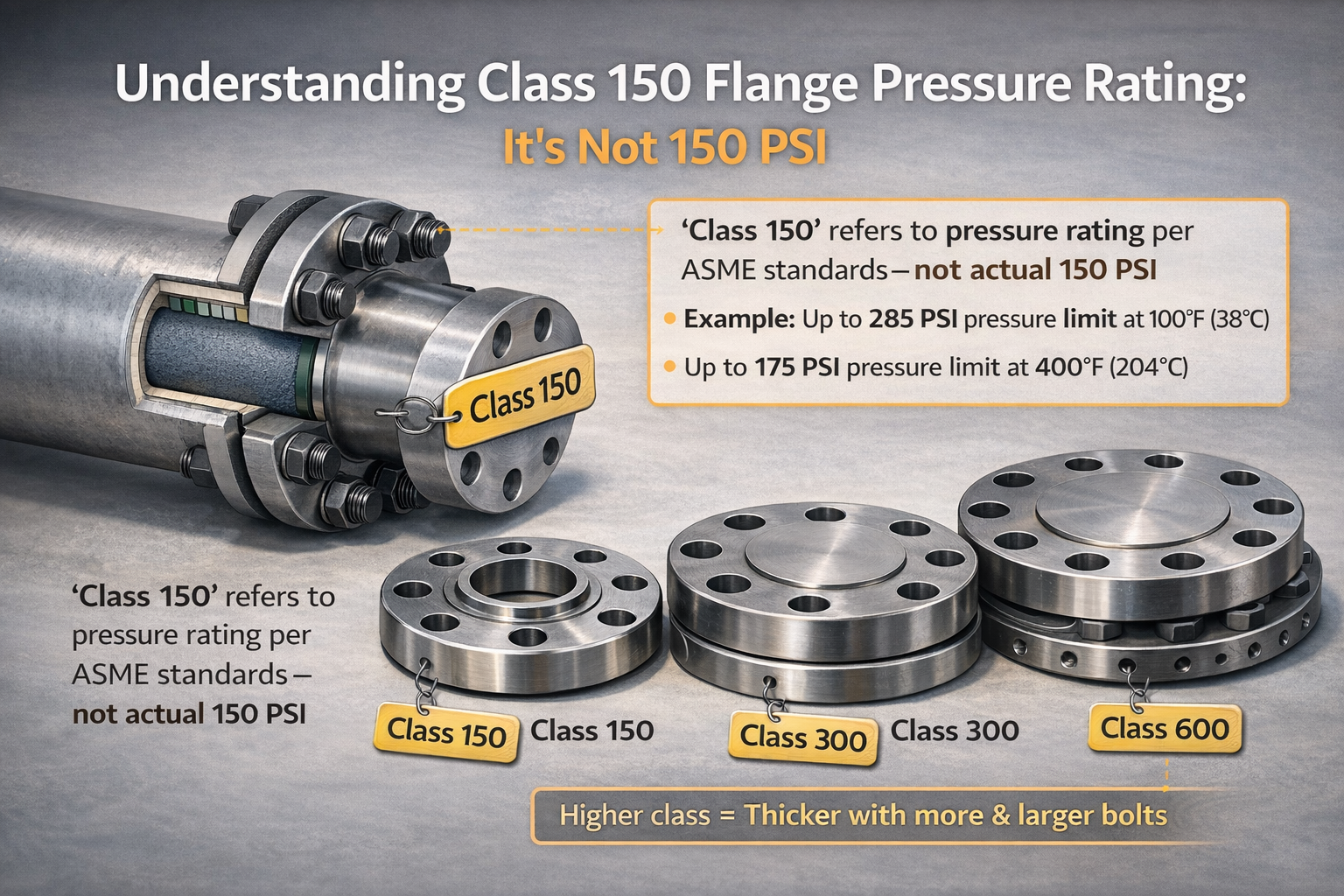
Pressure-Temperature Ratings: The Core Concept
As temperature increases, the strength of the flange material decreases. Therefore, the maximum allowable working pressure for the same flange goes down at higher temperatures.
The governing standard, ASME B16.5, provides pressure-temperature rating tables. You must use these tables to find the correct pressure for your specific material and temperature.
Here is a key example showing how pressure changes with temperature for common materials.
| Material Specification | At 100°F (38°C) | At 400°F (204°C) | At 600°F (316°C) |
| ASTM A105 (Carbon Steel) | 285 psi | 95 psi | 31 psi |
| ASTM A182 F304 (Stainless Steel) | 230 psi | 77 psi | 25 psi |
Important Note: These values are for illustration. You must always consult the latest ASME B16.5 tables for your project. The pressure at ambient temperature is often much higher than the class number.
What Does “Class 150” Actually Mean?
The class number (150, 300, 600, etc.) represents a pressure-temperature rating.
- A higher class number means a thicker, stronger flange with more or larger bolts.
- For the same material and temperature, a Class 300 flange can handle roughly twice the pressure of a Class 150 flange.
The class ensures that all flanges of that class have compatible dimensions (bolt pattern, thickness) and are designed to a corresponding strength level.
Key Factors That Determine the Pressure Rating
Several factors work together to set the final pressure rating for a flange.
| Factor | How It Affects the Pressure Rating |
| Material of Construction | The strength and temperature resistance of the steel (e.g., A105 vs. F304) sets the baseline. Stronger alloys can handle higher pressures at the same temperature. |
| Operating Temperature | This is the most critical variable. As shown in the table, pressure rating drops significantly as temperature rises. |
| Flange Type & Design | The flange geometry (Weld Neck, Slip-On, etc.) affects its strength. A Weld Neck handles stress better than a Slip-On. |
| Standards & Manufacturing | Flanges must be manufactured to a standard like ASME B16.5. This ensures the dimensions, materials, and pressure-temperature ratings are standardized and reliable. |
Frequently Asked Questions
Q: Can I use a Class 150 flange for a 150 PSI system at 500°F?
A: No. You must check the pressure-temperature table. For most materials, the rating at 500°F will be far below 150 PSI. Using it could be unsafe.
Q: How do I find the correct pressure rating for my project?
A: You need to know:
- Your flange material (e.g., A105).
- Your maximum operating temperature.
- Then, look up the value in the ASME B16.5 pressure-temperature rating table for Class 150.
Q: Are the ratings the same for all flange sizes?
A: Yes, the pressure-temperature ratings in ASME B16.5 are the same for all flange sizes within a given class and material. However, the physical dimensions (bolt size, thickness) increase with the Nominal Pipe Size (NPS).
Q: What’s the difference between Class 150 and PN10 or PN16?
A: Class 150 is an American ASME rating. PN10 and PN16 are European metric “Pressure Nominal” ratings. A PN16 flange is roughly similar to a Class 150 flange in pressure capacity, but their dimensions are completely different and they are not interchangeable.
Q: What if my service temperature is below ambient?
A: For low-temperature services, you must use a material rated for it, like ASTM A350 LF2. Standard A105 carbon steel can become brittle at low temperatures.
Conclusion
The Class 150 designation is the starting point, not the final answer. The safe working pressure is a variable that depends on your specific material and temperature. Always use the approved pressure-temperature rating tables from ASME B16.5 to determine the correct maximum allowable pressure for your application. This is essential for safety and system integrity.
Need help selecting the right flange class and material for your specific pressure and temperature conditions? Our technical team can guide you to the correct specification to ensure a safe and reliable connection.
Submit your project requirements for expert advice and a quote: http://texasflange.com/lp12/